Explore our library, where insights, press articles, and events are organized by tags, making it easy to find relevant topics.
interview December 2024 What's the Future of Fashion?
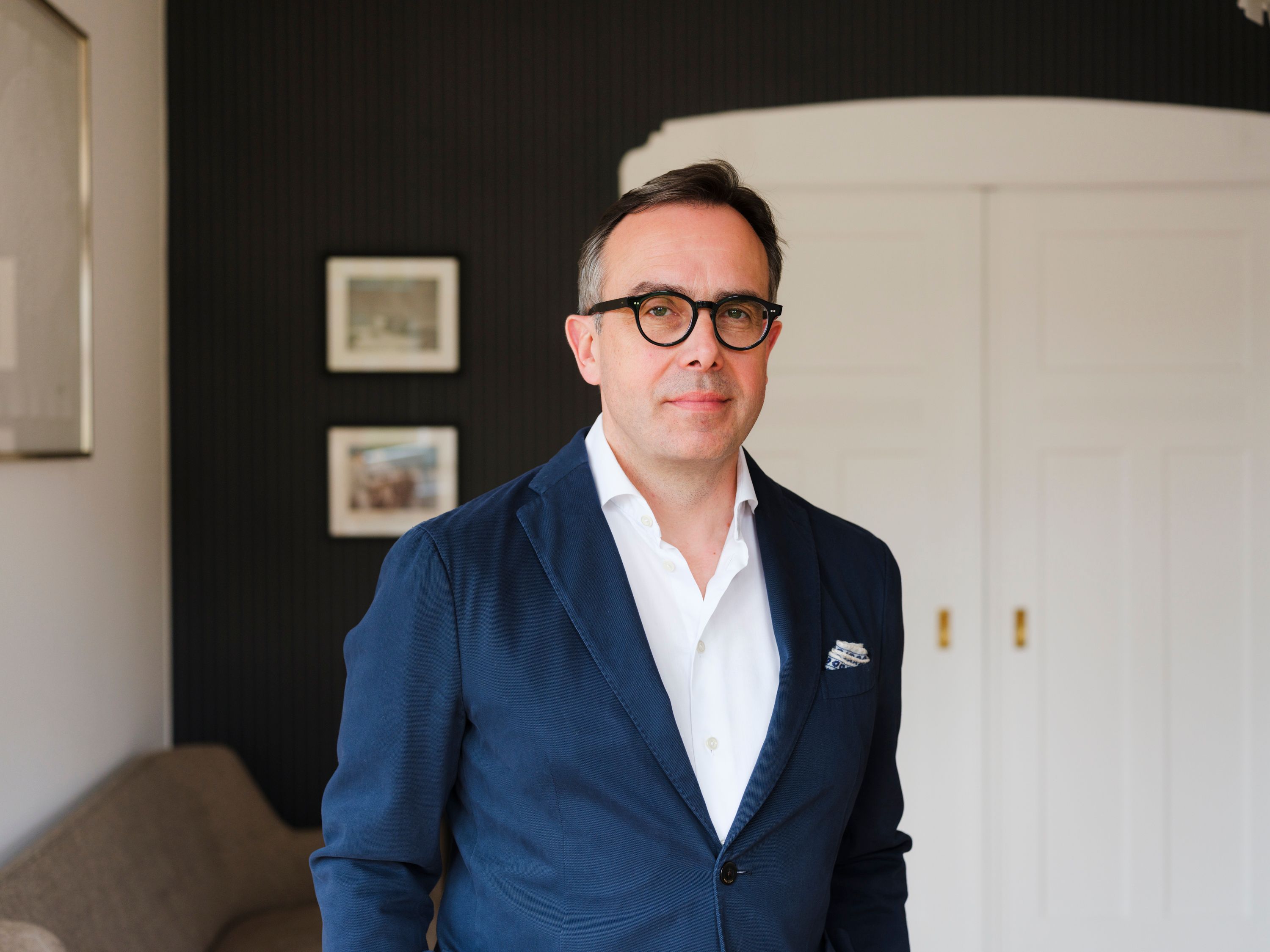
Interview by Tara Donaldson, Photography by Michael Kohlslinkedin January 2026 Fashion overstock is like fresh produce: if it doesn’t sell ...
There’s a prevailing belief in the industry that #digitization and #AI will finally solve the overstock problem. But off-price retail isn’t just a temporary fix - it’s a structural feature of the system, acting as a release valve for persistent oversupply. In challenging times like these, wholesale often plans too optimistically and relies on discounting and off-price channels as a fallback. The two-year value curve tells the story clearly. Products launched at full price with short shelf lives rapidly depreciate. Proprietary data from the team at smatch shows that after two years, discounted items typically retain only around 17% of their original retail value. In practice, that means clearing older inventory often requires markdowns of 74–83% off the original price.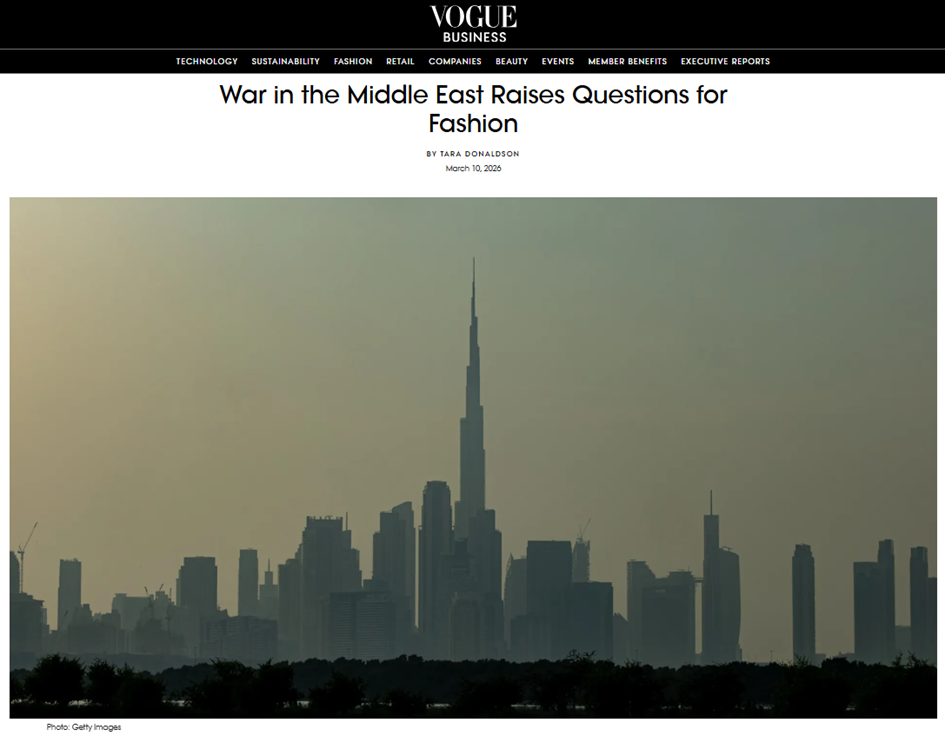
press March 2026 War in the Middle East Raises Questions for Fashion
Vogue Business by Tara DonaldsonAchim comments on the shifting outlook for luxury amidst the war in the Middle East.
Before the recent escalation, the Middle East was one of the few growth regions for luxury globally. However, Achim warns that disruption in the region will directly impact demand. While long-term fundamentals remain intact, he cautions that the duration of instability will determine the scale of impact – with short-term shocks affecting the current selling season and prolonged uncertainty posing broader risks to growth.
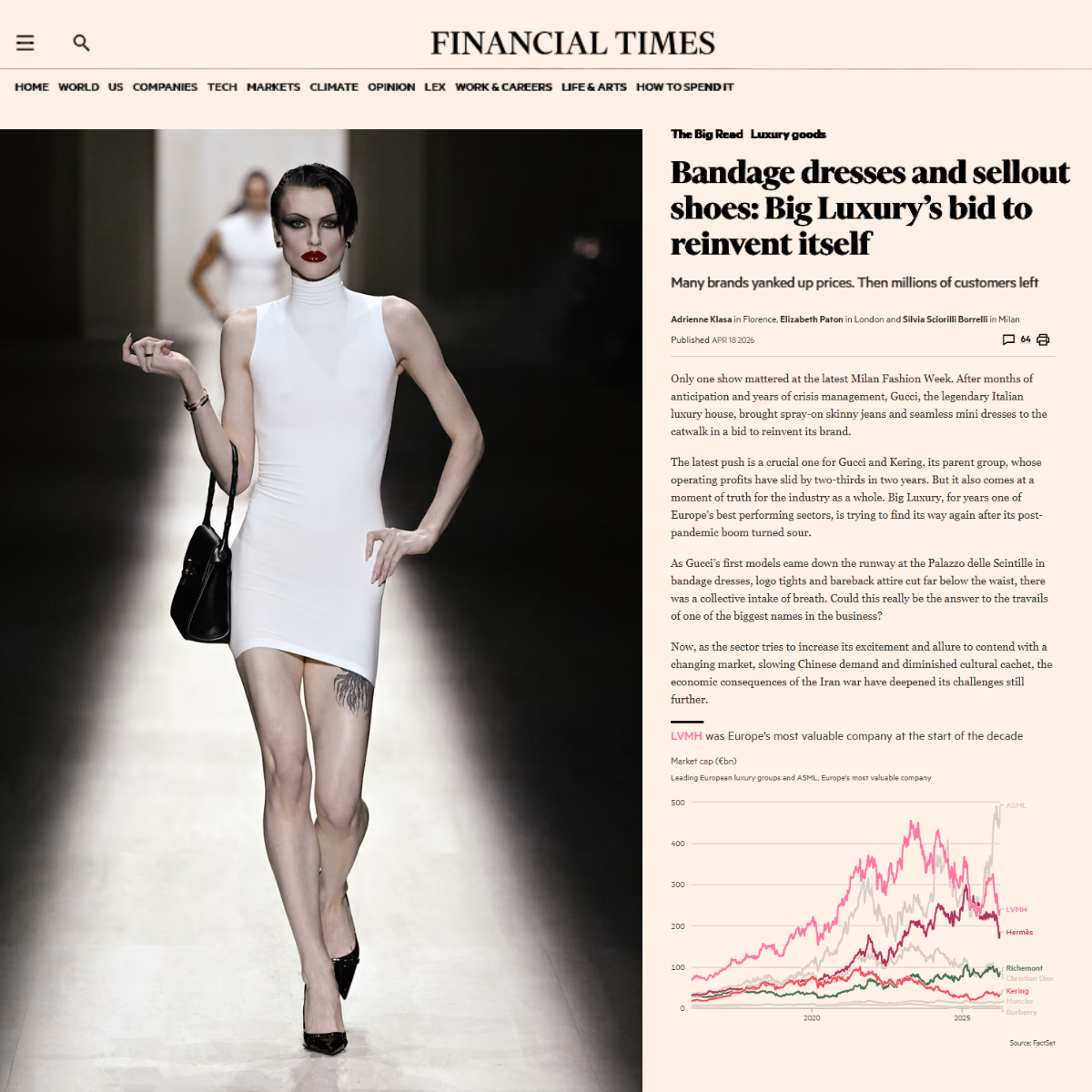
press April 2026 Bandage dresses and sellout shoes: Big Luxury’s bid to reinv...
Financial Times by Adrienne Klasa, Elizabeth Paton, Silvia Sciorilli BorrelliAchim comments on the current luxury slowdown and how increased conflict pressure is shaping the luxury industry’s outlook.
The post-fashion week mood offers tentative glimmers of optimism, but no meaningful shift in momentum. Achim highlights that the sector's challenges go far beyond the immediate impact of the Middle East conflict. While the conflict is directly affecting regional demand and suppressing tourism flows, its broader consequences – rising inflation and higher energy prices – are weighing on consumer spending appetite. Even with a quick resolution, recovery takes time, with delayed effects on the current selling season. The industry's structural challenges, from pricing to positioning, remain unresolved. Achim warns that external shocks should not distract from the industry's need for structural adjustment.
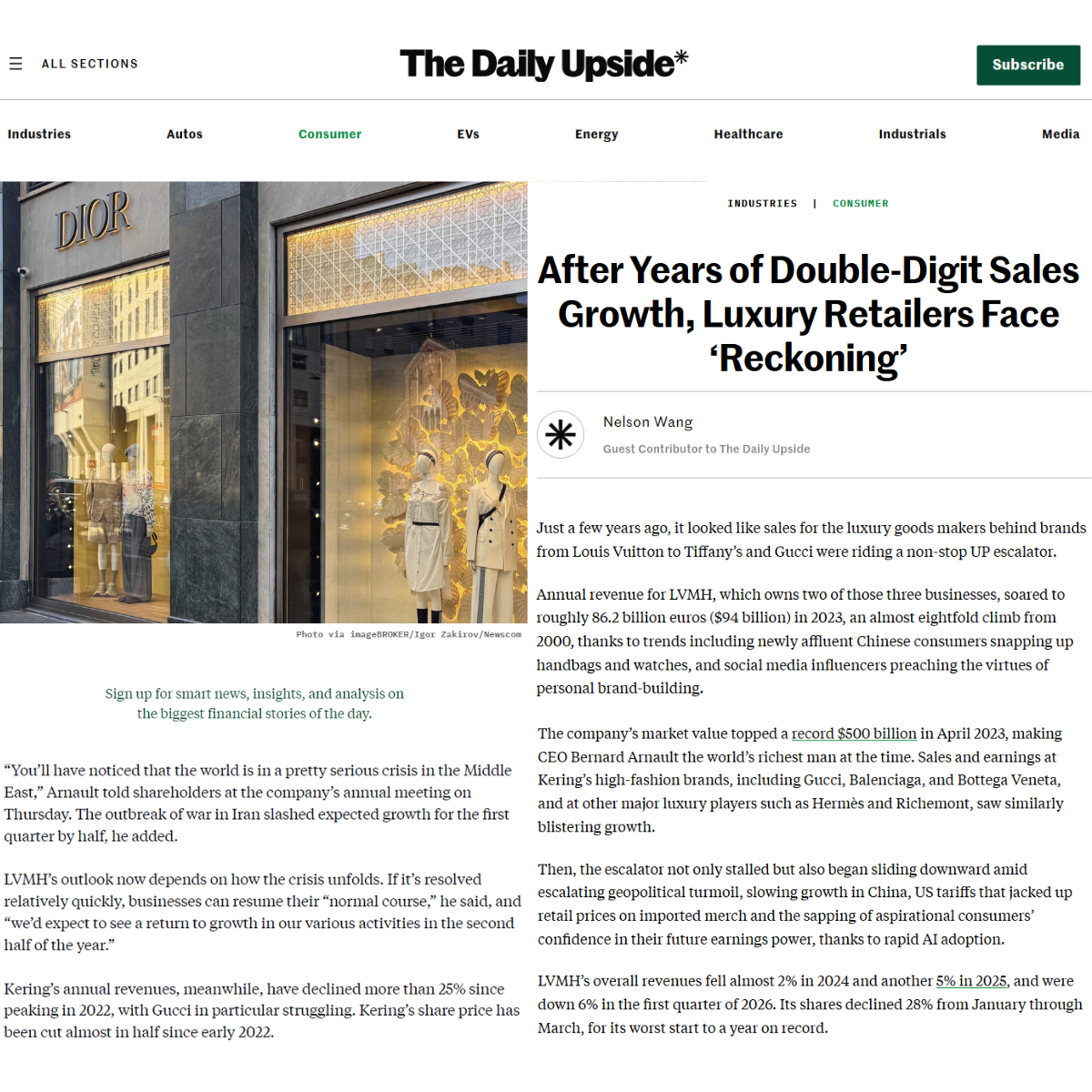
press April 2026 After Years of Double-Digit Sales Growth, Luxury Retailers ...
The Daily Upside by Nelson WangAchim discusses how self-inflicted structural issues contributed to the global luxury slowdown.
While luxury has had strong aggregate growth over recent decades, escalating geopolitical turmoil, slowing growth in China, US tariffs, and AI disruption have contributed to the industry's downturn. Achim states the luxury sector is in crisis, largely due to self-inflicted issues – particularly steep price increases that have alienated aspirational customers and lowered the perceived promise-to-value ratio. As a result, brands are making adjustments, such as expanding entry-level offerings and reshuffling creative leadership. Achim frames these efforts as the industry's early experiments to address and correct its challenges.
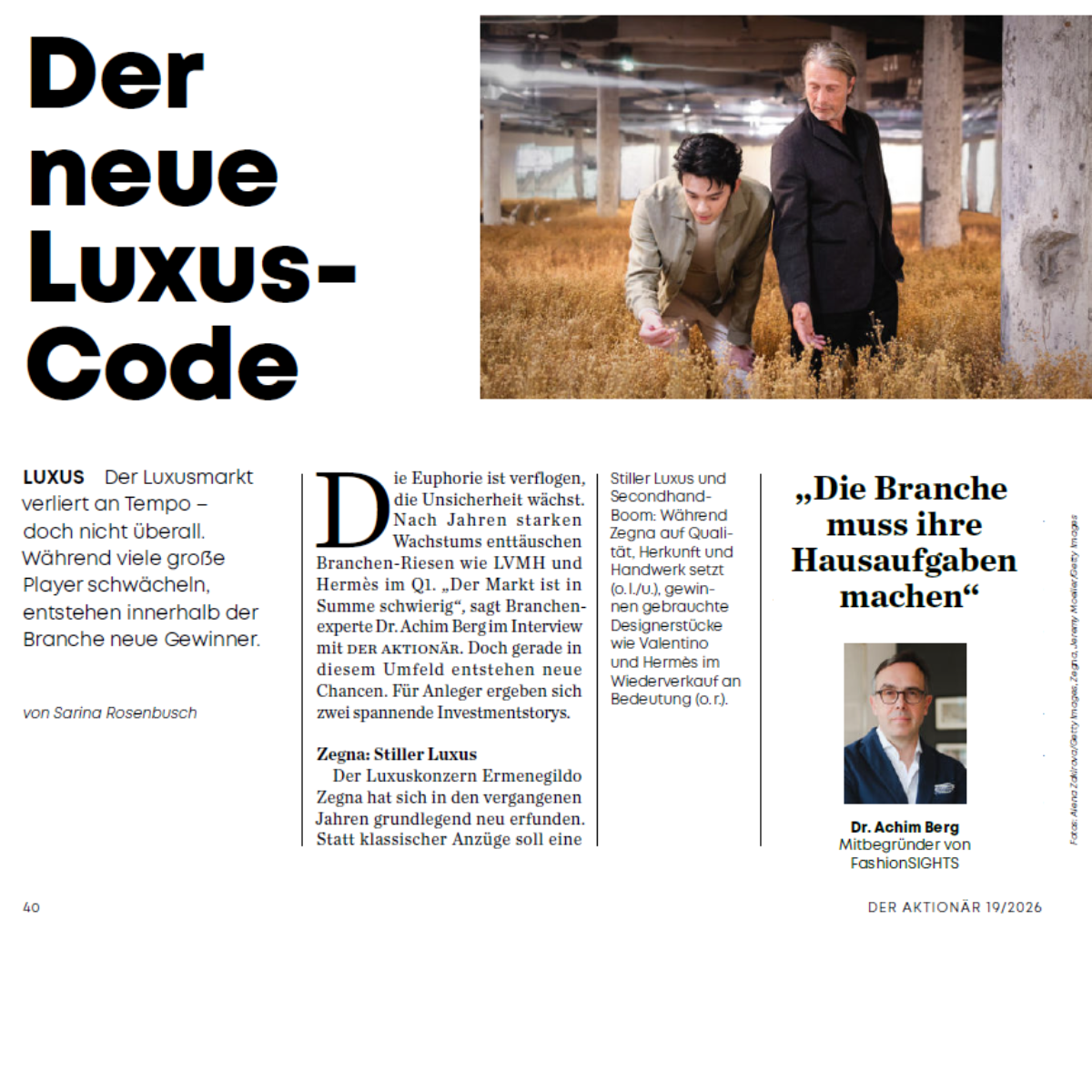
press April 2026 The new luxury code
Der Aktionär by Sarina RosenbuschAchim addresses current volatile dynamics challenging the luxury industry.
He sheds light on his perspective on the current forces influencing the luxury market. He assesses the repercussions of the Middle East conflict on the sector, what it will take for the sector to bounce back, and where luxury is heading. Achim points to a challenging market environment, highlighting the sharp decline in tourism throughout the Middle East, which has led to significant losses in retail traffic. He stresses the urgency for a widespread reset within the industry: luxury brands must address unchecked price hikes and prioritize quality and ongoing creative innovation. Expecting a return to double-digit growth is unrealistic – the sector will stabilize at more moderate rates.
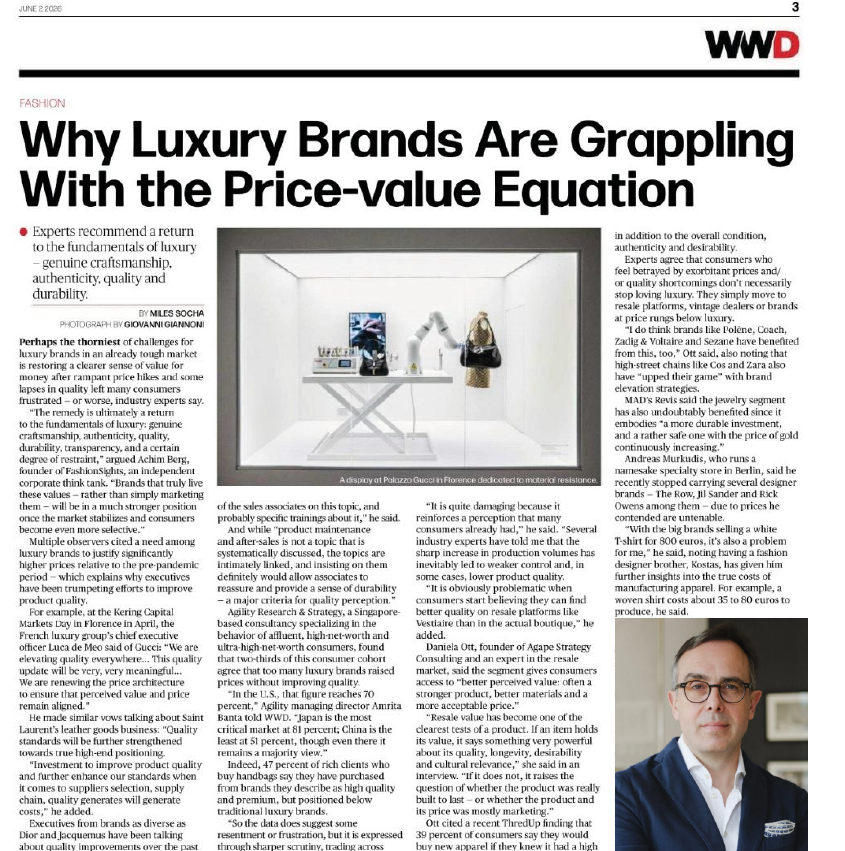
press June 2026 Luxury Brands Are Grappling With Issues of Price, Quality an...
WWD by Miles SochaAchim diagnoses luxury's self-inflicted crisis and sets out what a recovery demands.
Luxury is facing a credibility reckoning of its own making. Years of aggressive pricing, compounded by growing consumer scrutiny over craftsmanship and supply-chain practices, have deepened a mistrust many consumers already held. Post-pandemic buyers are no longer spending on aspiration alone - they are demanding justification. Achim’s prescription is a return to the fundamentals of luxury and restraint: craftsmanship, quality, and transparency. Brands that merely market these values rather than live them, he warns, will be exposed once the market stabilizes and consumer selectivity sharpens.
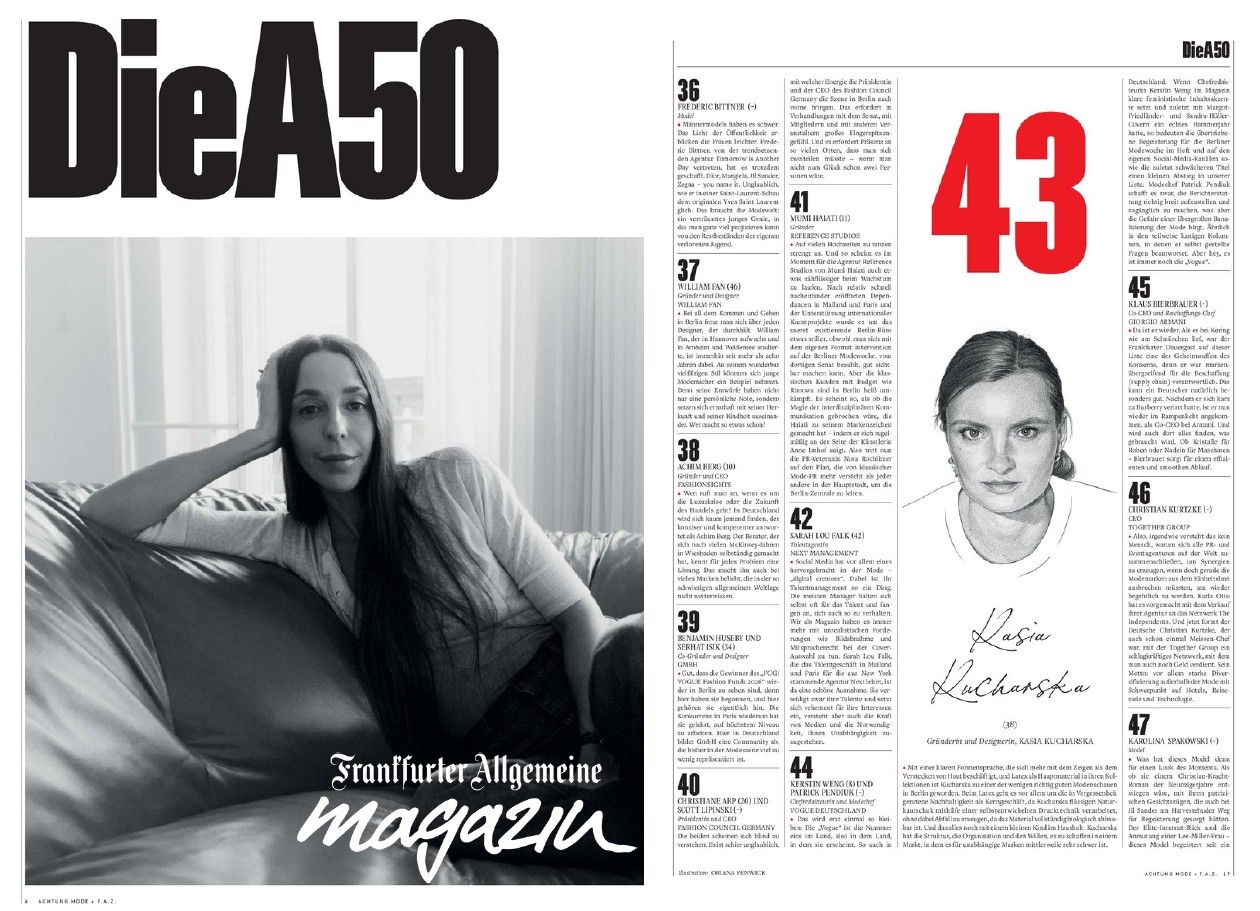
press June 2026 The list of the 50 most important Germans in fashion
FAZ Magazin, Achtung ModeAchim is named among Germany's 50 most influential figures in fashion, recognized as the expert with in-depth knowledge in the fashion industry.
Ranked #38 on FAZ Magazin's annual “A50” list, Achim is named as the first call in Germany when the conversation turns to the luxury reckoning or the future of the fashion industry. The publication spotlights his blend of strategic sharpness and entrepreneurial conviction. The combination that has made him vital to brands navigating today's macro environment.
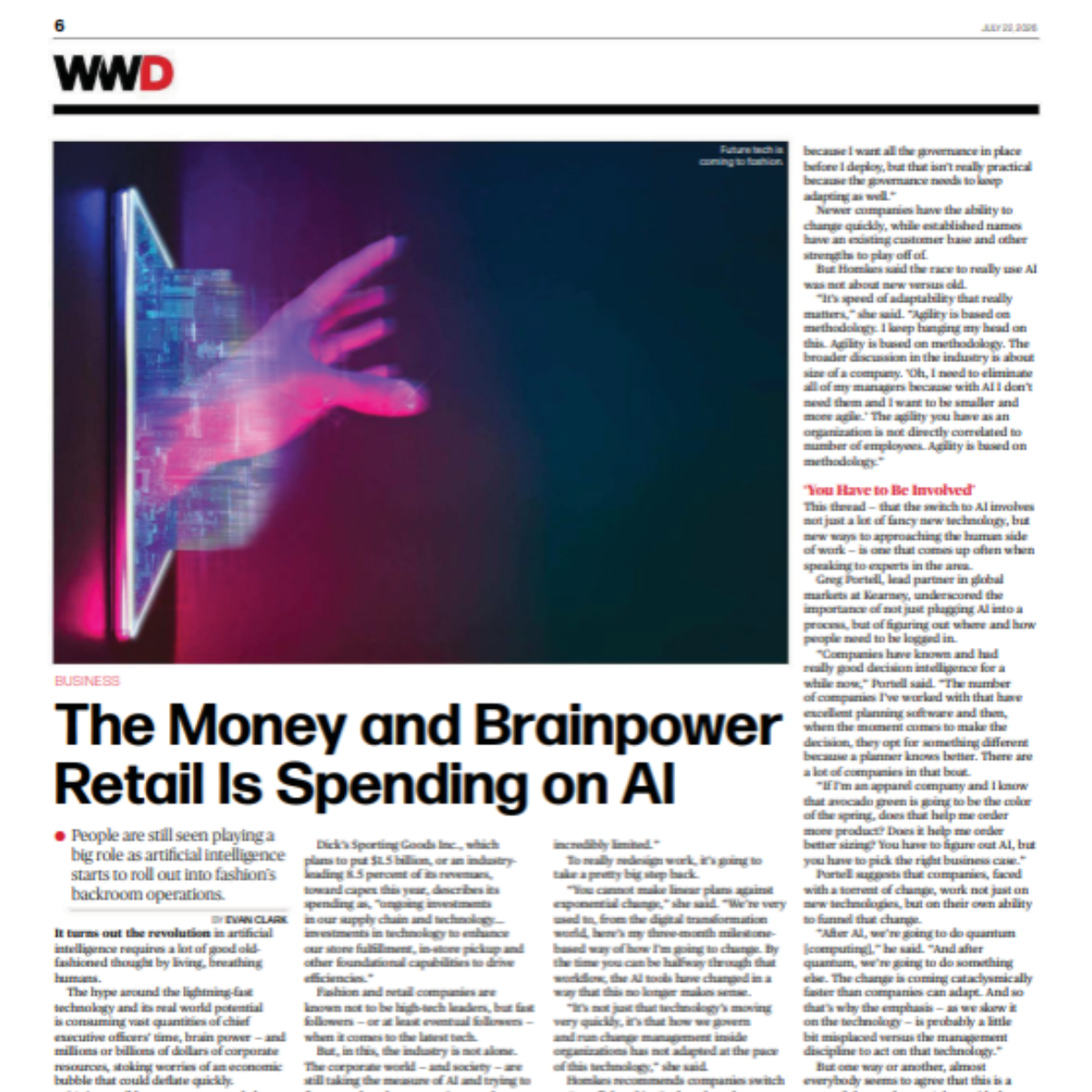
press July 2026 The Money and Brainpower Retail Is Spending on AI
WWD by Evan ClarkAchim weighs in on where fashion should direct its AI investments and why the real opportunity sits in the back end.
As fashion pours time and capital into artificial intelligence, companies across the industry are still working out where the technology genuinely creates value. Achim notes that most CEOs remain unsure how much to invest, recognising that AI now carries real costs requiring management and dedicated budgets. He highlights that while attention has centred on consumer-facing applications, the larger opportunities lie in a long-neglected area where lead times, buying, and sourcing processes have barely changed in decades. The pressing challenge for leadership is developing a plan that makes the return on investment tangible rather than vague.
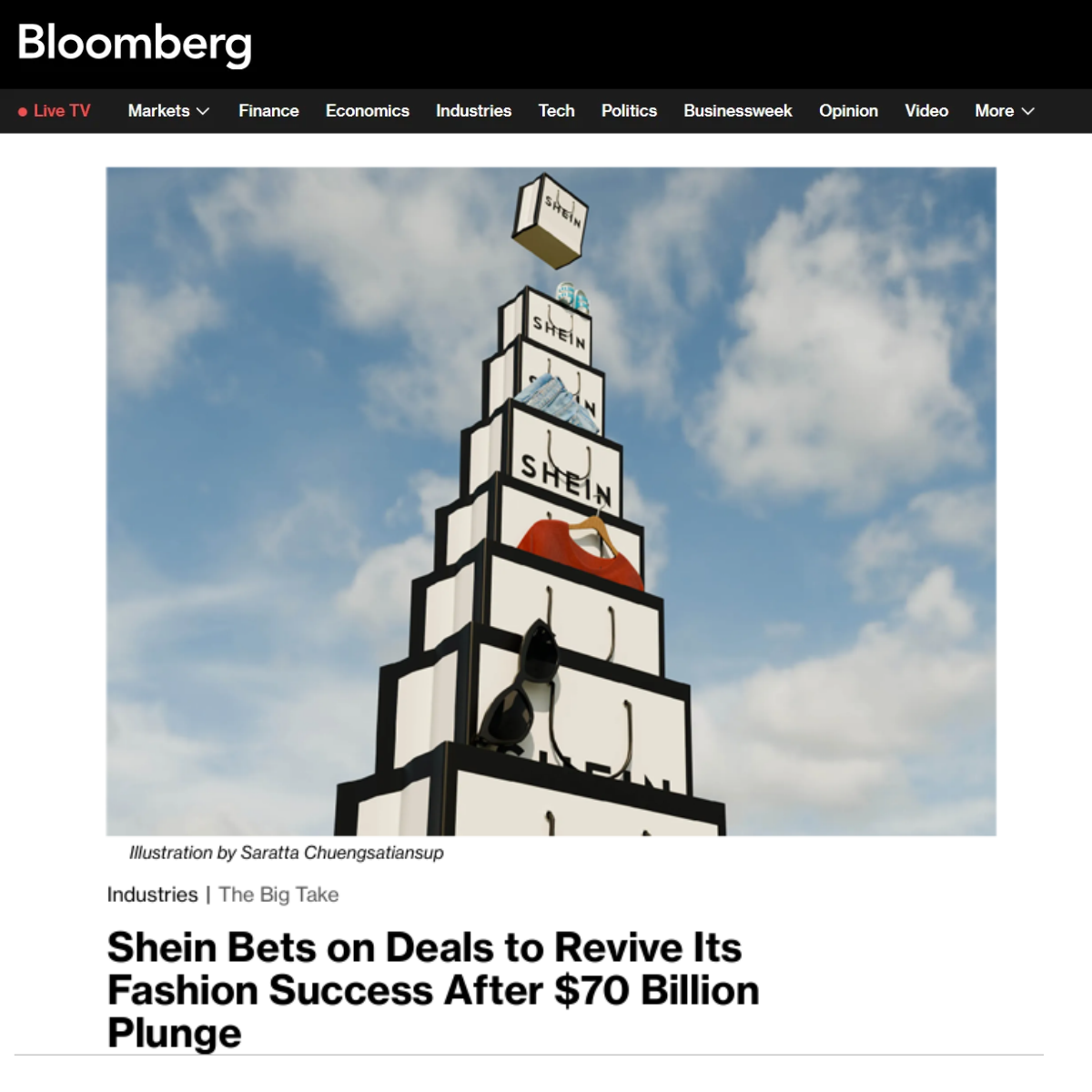
press August 2026 Shein Bets on Deals to Revive Its Fashion Success After $70 ...
Bloomberg News by Julia Fioretti, Daniela Wei, Dave Sebastian, Dong Cao, Olivia Poh, Martin Alfonsin Larsen and Erinn GardnerAchim reflects on Shein's public listing and the shifting conditions testing its once unstoppable model.
As trade barriers rise and geopolitical tensions reshape global retail, Shein heads into its long-awaited public listing at a fraction of its former valuation. The fast fashion giant is pivoting from pure direct-to-consumer growth towards acquiring and powering other brands through its supply chain infrastructure. Achim emphasises that the company's peak valuation was set in a very different world, one built for frictionless globalisation. Investors are now asking whether the model works equally well under new conditions, where the strengths that fuelled rapid expansion face fresh scrutiny. The listing marks a turning point for a business redefining its role in the industry.
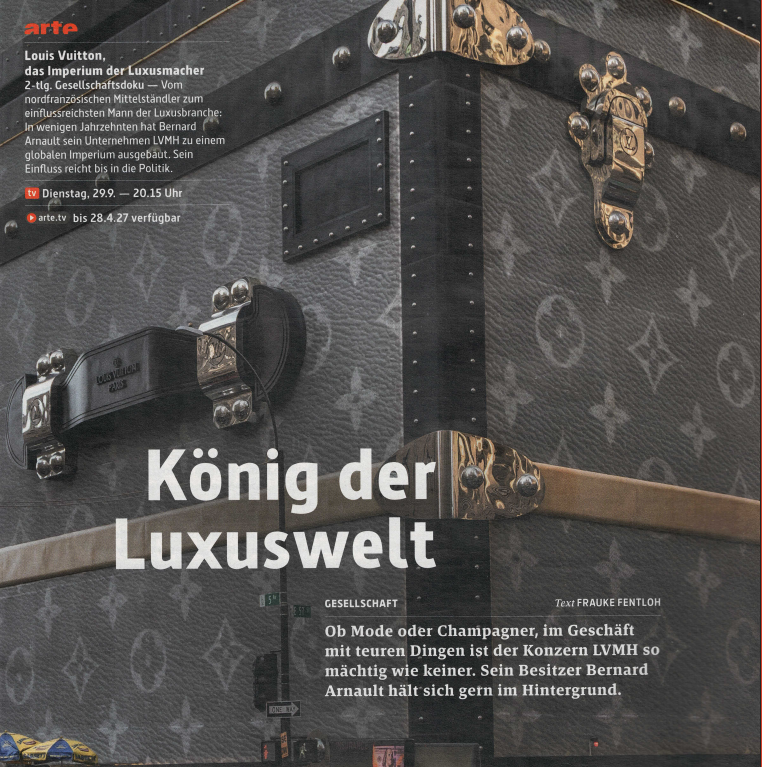
press September 2026 König der Luxuswelt
ARTE Magazin by Frauke FentlohThe article examines Bernard Arnault’s transformation of LVMH into a global luxury powerhouse, combining historic maisons with aggressive international expansion, creative reinvention and a broad portfolio spanning fashion, jewellery, hospitality and champagne. It also explores Arnault’s discreet but far-reaching influence, including his political connections and the question of succession within the family-controlled group. Achim Berg provides broader industry context on how the democratization of luxury and the rise of social media have significantly expanded the sector’s cultural relevance and desirability.
linkedin June 2026 (Garden) office beats home office
Spring days lie behind us, and as the days grow longer, lighter, and more summery, it shows at our FashionSIGHTS office, too. The first half of the year has been busy: lots of research, thinking, and client trips to Barcelona, London, Paris, Milan, Berlin, Amsterdam, and Mexico City. Now, as the season shifts, we're kicking it off properly with the opening of our hashtag#garden office. Those who have been following FashionSIGHTS closely know that a year ago, there was no garden to speak of. Now the whole team gets to enjoy a green, open space. On sunny days, it becomes our second office and the place where our best thinking happens. And why we all do home office, when it suits the schedule, we prefer to be working together as a team. (Garden) office beats home office. Looking ahead, the months before the summer break are busy. We're finalizing our interview series and are focusing on our book project. We're also expanding the team in the coming weeks. Whats your view? Do you prefer office, garden office or home office? What is best for your team?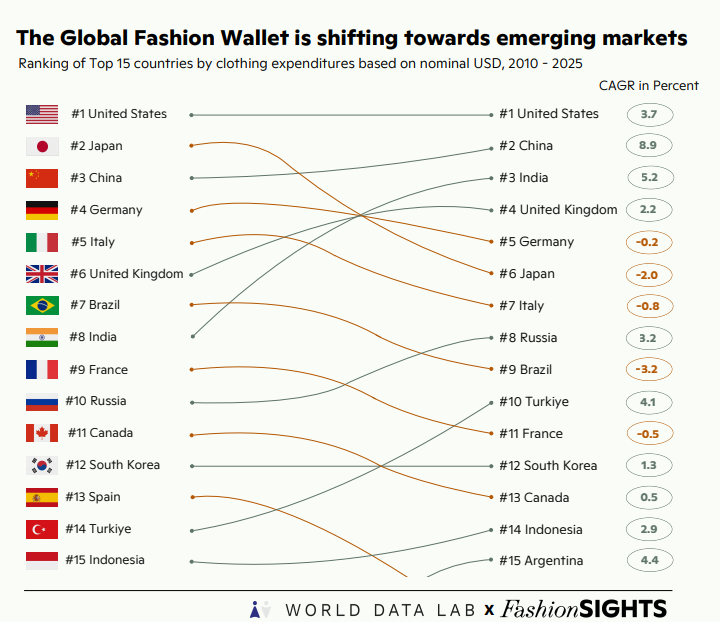
linkedin June 2026 The global fashion wallet is shifting.
The top 15 countries for clothing and footwear spending look very different today than they did 15 years ago. While the US remains #1, the real story lies beneath the surface: the ranking is becoming more competitive and growth momentum is increasingly shifting toward emerging markets. Three observations stand out: 1. The entry bar has been raised In 2010, Indonesia entered the top 15 with around $22 billion in clothing and footwear expenditure. In 2025, Argentina needed roughly $30 billion to claim the same spot. While inflation explains part of this increase, more consumer economies are reaching meaningful scale, making the lower end of the ranking increasingly competitive. 2. Emerging markets are reshaping the leaderboard India climbed from #8 to #3. Turkey moved from #14 to #10. Argentina entered the top 15. Meanwhile, several mature markets lost relative ground: Japan fell from #2 to #6, Italy from #5 to #7, France from #9 to #11, and Spain dropped out of the ranking entirely. Not all declines reflect weaker consumer demand. In Brazil and Japan, currency depreciation against the US dollar significantly reduced nominal spending growth when measured in USD, despite continued growth in local-currency terms. The strongest upward moves, however, are coming from large consumer economies where rising incomes are expanding the consumer class. Since 2010, China and India have seen a strong increase in the share of their populations with meaningful discretionary spending power, which in turn fundamentally reshaped fashion demand. 3. The US still leads, but China is closing the gap The US remains the world's largest apparel market, with spending rising from approximately $273 billion to $470 billion between 2010 and 2025. China's trajectory is even more remarkable. While moving up "only" one position, from #3 to #2, its clothing expenditure grew at nearly 9% CAGR over the period, reaching $324 billion and steadily narrowing the gap with the US. Behind that growth is a profound shift in consumer purchasing power. In 2010, only around one-fifth of China's population belonged to the consumer class. Today, that figure exceeds 70%. Turkey tells a related story. While it already had a sizeable consumer class in 2010, its wealthy population expanded from roughly 1 million to 19 million people over the period, providing a powerful tailwind for fashion spending. The broader takeaway: Fashion consumption is being redistributed. The next phase of growth will require understanding where consumer spending power is created in the future. Thank you to World Data Lab for sharing the data and insights behind this analysis. Source: World Data Lab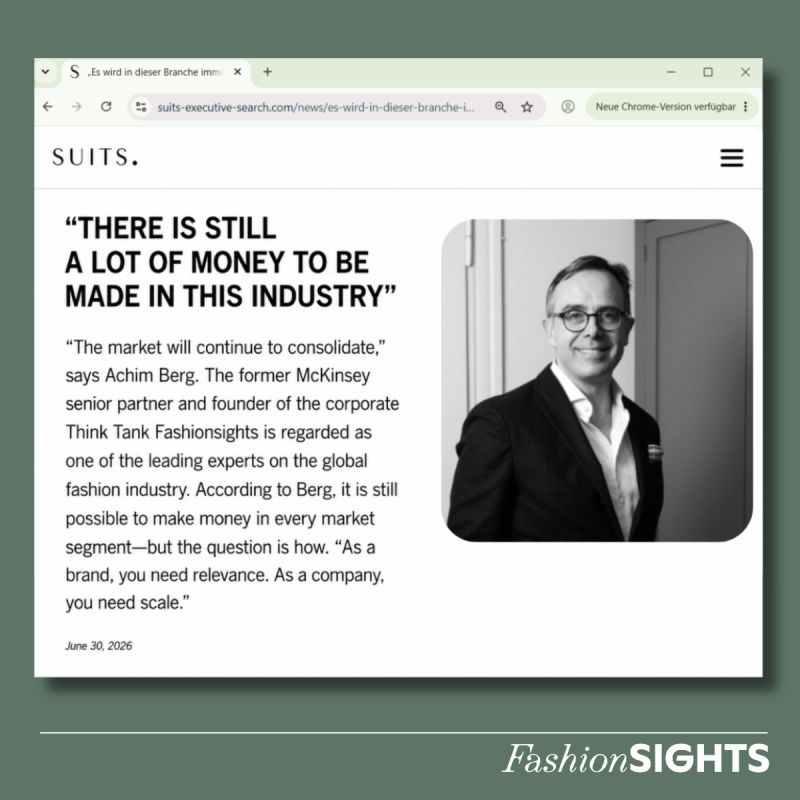
linkedin June 2026 A lot of money is still being made in the Fashion industry!
This time, I was the interviewee sharing my perspective on the status quo of the fashion industry. I sat down with Jürgen Müller from SUITS. Executive Search for his publishing format profashionals. Globally, fashion is still a $2 trillion industry. So why does it feel as if so many companies were caught off guard? Because the pressure to change was never high enough. Too many companies stood still like a deer caught in the headlights. When decent money is still being made, it is easy to believe that the good old days will return. But they won’t. Wardrobes in the West are full. Consumers are spending less on clothing. This is not cyclical. It is structural. So what will separate winners from losers going forward? As a brand, you need relevance. As a company, you need critical mass. Ten years ago, €1 billion in revenue could give you that scale. Today, you probably need €3 to €5 billion. The market will continue to consolidate. First in the mid-market, now increasingly in premium. But brands rarely disappear; companies do. They are bought, licensed, absorbed or integrated. The shelf does not necessarily get shorter, which is why consolidation is happening right under our noses, often unnoticed. Full interview linked in the comments. Many thanks, Jürgen Müller for having me. FashionSIGHTS #FutureOfFashion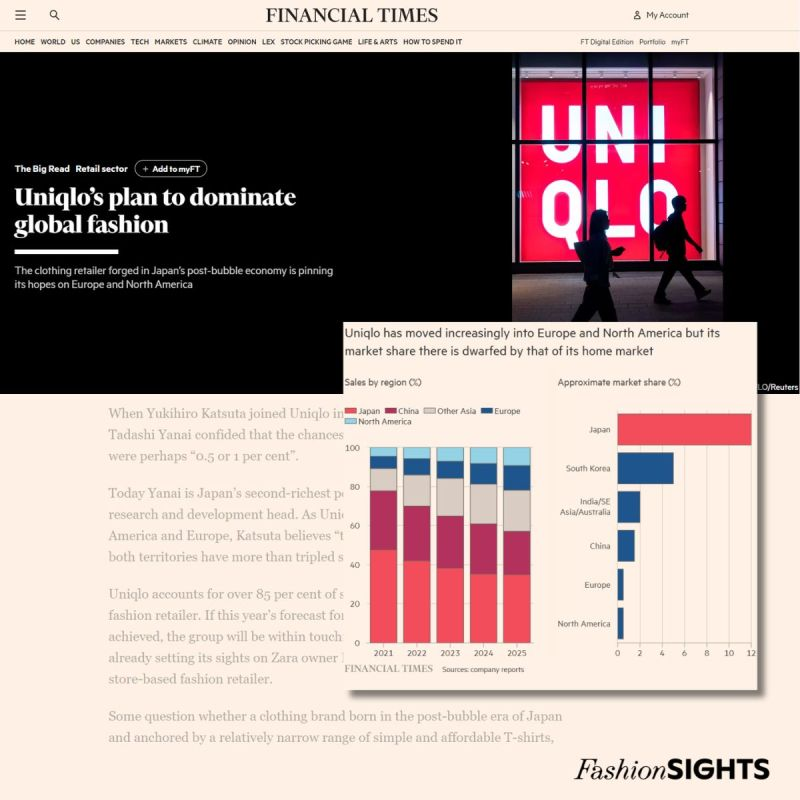
linkedin July 2026 Can UNIQLO crack the US and Europe?
That was one of the questions I discussed with Harry Dempsey, Tokyo correspondent for the Financial Times. His latest FT Big Read explores Uniqlo’s ambition to become a dominant force in global fashion. While Uniqlo remains exceptionally strong in its Japanese home market, the brand has recently seen impressive growth in both Europe and North America. With its proposition of offering high-quality wardrobe essentials at an affordable price point, Uniqlo’s recent rise has also benefited from broader shifts toward modesty and quiet luxury. The question now is how much more value the brand can create before that momentum begins to fade. Uniqlo’s ambition to lead in global fashion are nothing new. In 2008, Uniqlo set the goal of becoming the world’s No. 1 apparel retailer by 2020. In 2017, Fast Retailing CEO Tadashi Yanai stated that the company would overtake industry leader Zara. Even though the brand has not fully achieved those targets yet, the scale of its accomplishments becomes clearer when looking at the numbers. Around 85% of Fast Retailing’s revenue comes from Uniqlo, and between 2008 and 2025, the company grew at a CAGR of 11%, increasing revenue from approximately $3.9 billion to $22.7 billion. Over the same period, H&M and Zara grew at around 6% and 8% CAGR, respectively. Uniqlo is slowly but steadily closing the gap with its European rivals. Whether it can translate its success into true leadership in Western markets remains one of the most interesting questions in global fashion retail. Thank you, Harry Dempsey, for featuring me and our FashionSIGHTS analysis in the article. You can find the link to the FT Big Read in the comments. Source: Finacial Times, FashionSIGHTS analytics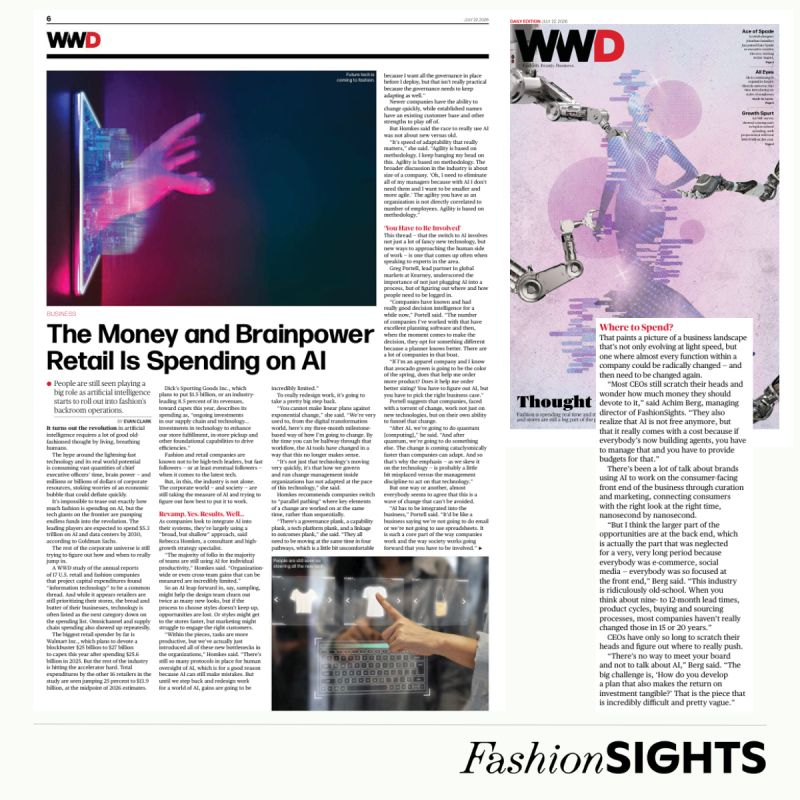
linkedin August 2026 “It turns out the revolution in artificial intelligence requ...
That is how Evan Clark opens his WWD deep dive into hashtag#AI spending in retail. I shared some of my own views in the article. First, the numbers tell part of the story. WWD reviewed the CapEx plans of 17 major US retail and fashion companies. Excluding Walmart, the remaining 16 expect their combined CapEx to rise by 25% to approximately $13.9 billion in 2026, based on the midpoints of their estimates. Of course, much of that investment remains directed toward stores. But information technology frequently appears next on the spending list, alongside omnichannel and supply-chain investments. However, more CapEx does not automatically mean money is well spent. For years, fashion companies have focused on the front end: e-commerce, social media, personalization, and the digital customer journey. Understandably so. But I see a larger, less obvious opportunity on the back end, particularly in product development, buying, and sourcing processes that many companies haven't fundamentally changed in 15 or 20 years. Take Levi Strauss & Co. as an example. CEO Michelle Gass said the company is nearing the end of a years-long ERP transformation that has improved its data and laid the foundation for incorporating AI into company processes. They are now deploying about 1,000 agents across supply chain, planning, and wholesale orders. But where does it go from here? Ten thousand agents? Hundred thousand? Nobody quite knows yet. This brings me to a more difficult leadership question. Budget planning must go hand in hand with accountability and measuring results. How do companies make the return on AI investment tangible? Who supervises the agents once they become part of operational processes? And who decides what success looks like? Over the past months, I have interviewed many of the industry’s leading executives for my upcoming book. AI frequently came up as an opportunity for fashion companies to rethink how they design, plan, source, operate, and even authenticate products. We will share more of what we learned soon. Thank you, Evan for including my perspective in this excellent piece. Link to the WWD article in the comments.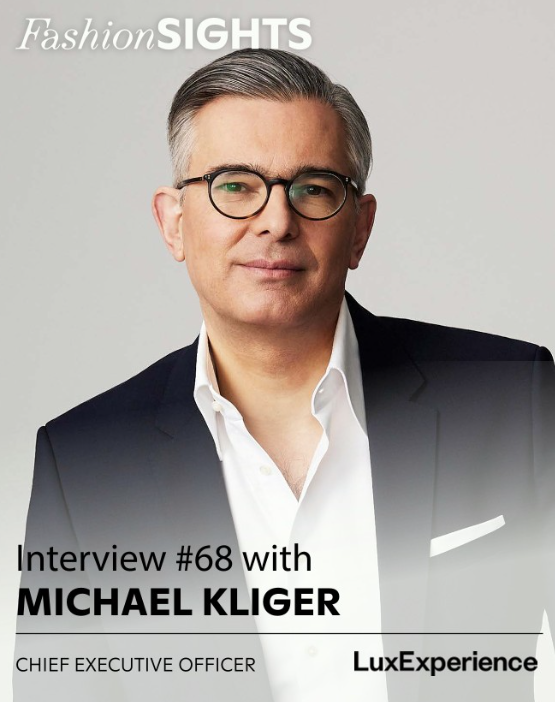
linkedin September 2026 Interview #68 with Michael Klieger, CEO; LuxExperience
The Future of Luxury E-Commerce Looks Bright Few people have had a better front-row seat to the evolution of luxury e-commerce than Michael Kliger. After more than a decade leading Mytheresa, he is now CEO of LuxExperience, bringing together Mytheresa and NET-A-PORTER. Michael believes luxury e-commerce is in better shape than it was two years ago: consolidation has left fewer players, inventories are healthier, discount-driven models have come under pressure, and the focus has shifted towards profitable growth and high-value customers. And the growth story is far from over. He believes online could eventually account for 30–40% of luxury sales, driven not only by technology but by something increasingly valuable to affluent consumers: time. “E-commerce doesn’t need to replicate the store. It needs to solve for time – and time has become the most expensive currency there is.” A great conversation about why the shakeout of recent years may ultimately have made luxury e-commerce stronger and why its next chapter could be one of its most interesting yet. This conversation was part of the interview series for my upcoming book on the Future of Fashion, to be published early next year. Thank you, Michael, for being part of the journey and for sharing your perspective.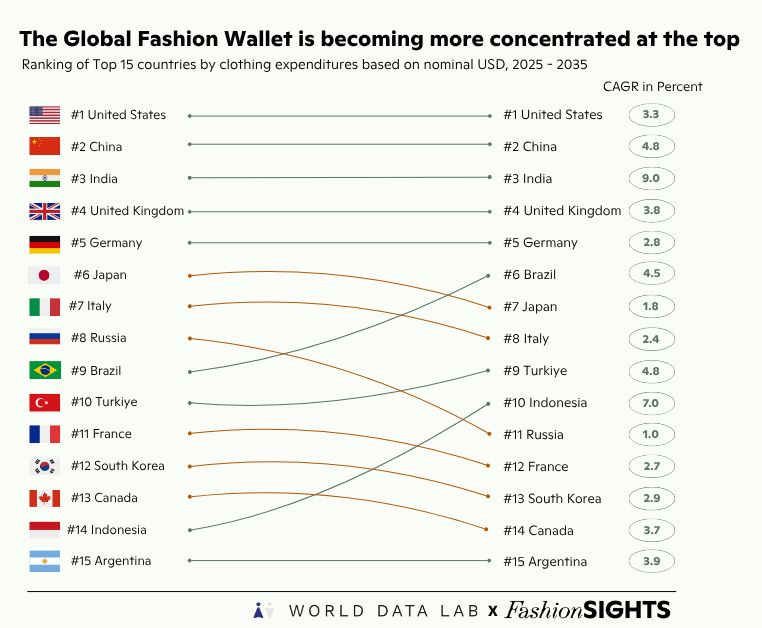
linkedin September 2026 From Hindsight to Foresight: Where Is Demand in the Fashion ...
Our previous analysis looked back at the growth of clothing and footwear spending from 2010 to 2025. Now we're looking ahead. By 2035, the world's five largest apparel markets will remain unchanged: the U.S., China, India, the U.K., and Germany will stay in the top 5. Does it mean that everything is staying the same? Not quite. 1. Scale still wins Between 2025 and 2035, clothing and footwear spending in the U.S. will increase by $183 billion, from $470 billion to $653 billion, a CAGR of approximately 3.3%. China will see an increase of $192 billion, reaching $516 billion at a CAGR of 4.8%, still the largest absolute growth of any market worldwide. 2. India is growing faster than any market in the top 15 India records an increase of $148 billion, growing from $108 billion to $256 billion at a CAGR of 9%, faster than any other market among the top 15. What is the possible reason for this? World Data Lab forecasts that India's middle class will double to about 800 million people by 2030, growing at an annual rate of about 8.5%, compared to about 6% for China's middle class. 3. Movement is happening outside the top 5 Spain, which was still among the top 15 in 2010, has fallen out of the top 15 by 2025. Instead, emerging countries continue to grow. Indonesia's market will nearly double, from $33 billion to $65 billion, moving the country up to 10th place. Brazil grows from $54 billion to $83 billion and moves up from 9th to 6th place. Another part of the truth is that the top 3, the U.S., China and India, account for 58% of top-15 clothing and footwear spending in 2025, rising to 62% by 2035. The gap between #3 (India) and #4 (the U.K.) widens from $14 billion to $118 billion. The point worth emphasizing, both in retrospect and as we look ahead, is this: growing cities, demographic changes, and an emerging middle class are early signals of where new demand will stem from. Many thanks to our partners Marco Fengler and Thomas Bauer at World Data Lab for the data and insights underlying this analysis.

