Explore our library, where insights, press articles, and events are organized by tags, making it easy to find relevant topics.
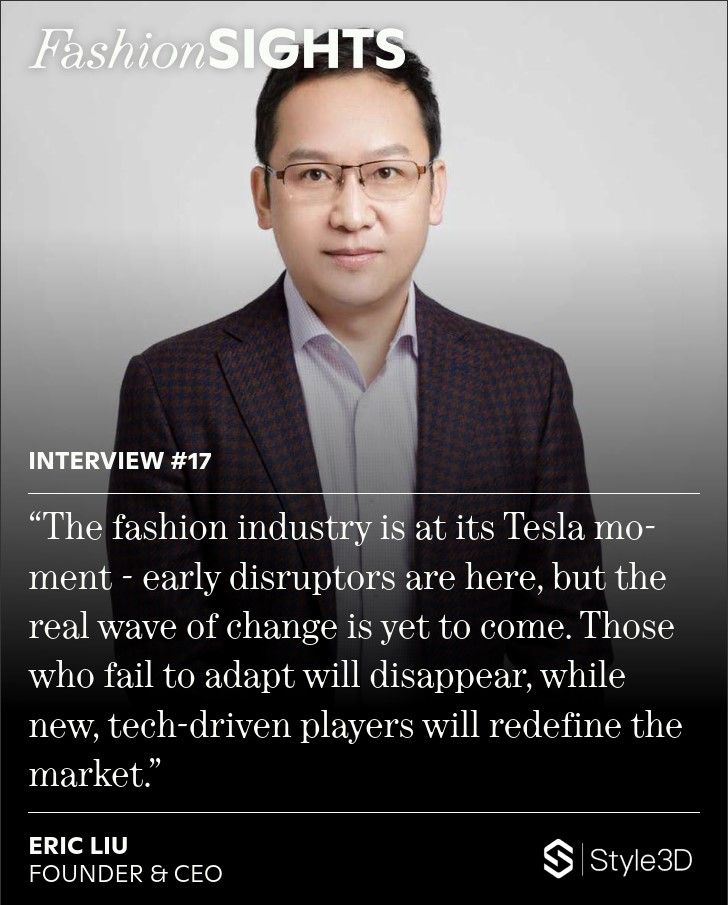
linkedin Interview #17 - Eric Liu; Founder & CEO Style3D
Is the Fashion Industry Having Its #TESLA Moment? That was at the heart of my conversation with Eric LIU, founder and CEO of Style3D. Eric is a true pioneer, driving the digital transformation of fashion’s back-end processes. With over 20 years of experience, he founded Style3D in 2015, blending his expertise in computer science with hands-on experience in apparel manufacturing.
event February 2026 WAIR Expert Exchange - 24 hours - Fast track to AI in fashio...
How will AI-powered merchandising, digital agility, logistics innovation, and next-generation supply-chain models are redefining the industry. This event isn’t just about visionary thinking—it’s about real, actionable transformation that retail leaders can put into practice immediately.
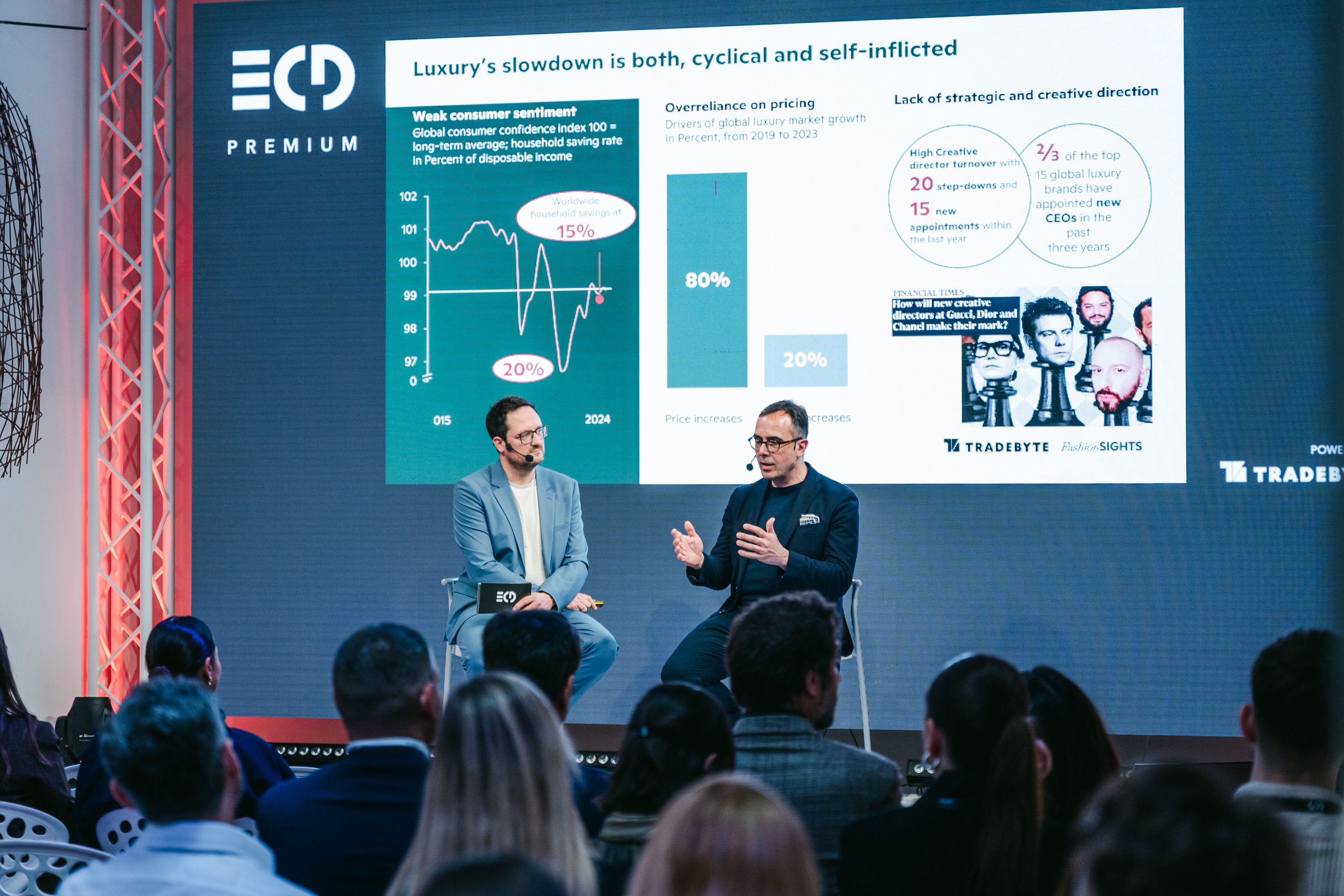
event March 2026 Tradebyte - ECD Premium
In partnership with Tradebyte, Achim is invited to hold a keynote conversation on the state of luxury in e-commerce, the rise of Agentic AI, and the evolving role of platforms.
The conversation also focuses on what comes next – from restoring creative momentum and sharpening strategic focus to embracing new technologies such as AI that are beginning to reshape operations and content production.
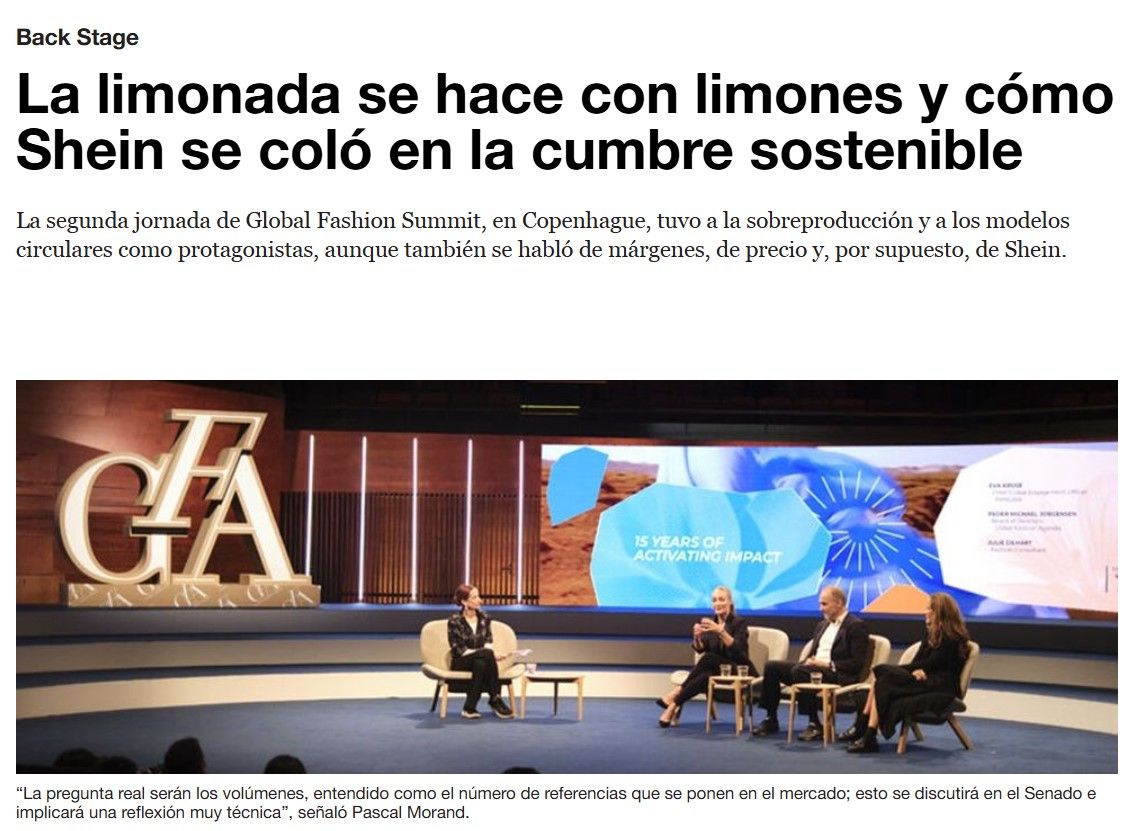
press May 2024 Lemonade is made with lemons and how Shein snuck into the Su...
Modeas.com by Pilar RiañoAchim speaks about circular business models, emphasizing the need to make these models more profitable in order to achieve sustainable growth.
The second day of the Global Fashion Summit in Copenhagen focused on sustainability, circular business models, and overproduction, with critiques of the fashion industry's current practices, including Shein's business model. Speakers emphasized the need for transformative change in the industry, highlighting circularity, creativity, and new regulations, while acknowledging challenges like reduced margins and increased complexity. The French government’s anti-Shein law, aimed at fast fashion regulation, and the call for companies to adapt to new market trends, were key topics discussed.linkedin January 2026 Smatch - raised €7.3m in Seed funding.
smatch is an AI-powered B2B marketplace transforming how unsold fashion hashtag#inventory is traded globally. By intelligently matching each item with the right buyer, smatch helps sellers regain control over distribution and margins, while buyers gain real-time access to a wide range of verified inventory. All transactions are discreet, fast, and data-driven. The opportunity is significant. In Europe alone, an estimated €300bn worth of fashion inventory is either heavily discounted or never sold, impacting profitability, brand equity, and sustainability efforts. Since launching in 2023, more than €15bn in inventory and 190 million items have offered to the platform. To support the next stage of growth, the team around Dr. Max Groberg and Dr. Hans-Martin Vetter has now raised €7.3m in Seed funding. The round was co-led by Transition Ventures, 42CAP, and 10x Founders, with backing from exceptional industry leaders including Noel Kinder (lululemon, former Nike CSO), Nigel Griffiths (former adidas SVP Global Sales), and myself.linkedin February 2026 Why the fashion industry needs to innovate!
I had the pleasure of speaking at the 24h Circular Fashion Journey in Amsterdam, organized by GS1 Netherlands and WAIR Retail Geeks. Pressure on the industry is mounting from all sides: macro uncertainty, squeezed margins, rising ESG expectations, and rapid technological change. Yet meaningful innovation remains limited. Most business models are still being stretched, not rethought. In Amsterdam, we explored the structural forces reshaping fashion today and made a deep dive on four challenges in particular: · The end of deflationary sourcing and logistics marking a structural cost reset that permanently changes the margin equation · Accelerating ESG regulation pushing circularity from strategic option to license to operate · A lack of true, system-wide innovation with too much focus on front-end and, apart from a few exceptions, not enough reinvention of the back-end · Rapid industry polarization and fragmentation where scale winners pull ahead while the rest struggle to stay relevant We further identified six concrete action points for brands to stay competitive in this challenging environment: 1. Reach critical mass or commit to a niche 2. Take back-channel control 3. Protect margins with cost discipline 4. Integrate technology end-to-end 5. Transform for sustainability from claims to proof 6. Embrace flexibility as a core capability With GS1’s work on product identification and Digital Product Passports accelerating, the link between regulation, transparency, and competitiveness is becoming impossible to ignore. A big thank you to Bram Broeks, Mitch van Deursen and ★ Steven Witteveen for the invitation, and for bringing together so many inspiring individuals and brands like Steve Madden and PVH Corp. And, thanks to everyone who contributed to such open, forward-looking discussions.linkedin March 2026 Luxury reality check in Milan
Last week, Tradebyte brought together an inspiring group of industry experts for ECD Premium in Milan – arguably a great setting to discuss the state of luxury in e-commerce, the rise of Agentic AI, and the evolving role of platforms. A particular highlight was the presentation of the new Tradebyte Premium report "Luxury in the Age of Algorithms", which set the stage for our keynote conversation on the State of Luxury in 2026. In the discussion, we explored why the industry has reached an inflection point: after decades of expansion, growth dynamics are shifting, consumer sentiment has softened, and the sector is increasingly confronting the limits of price-led growth. The conversation also focused on what comes next – from restoring creative momentum and sharpening strategic focus to embracing new technologies such as AI that are beginning to reshape operations and content production.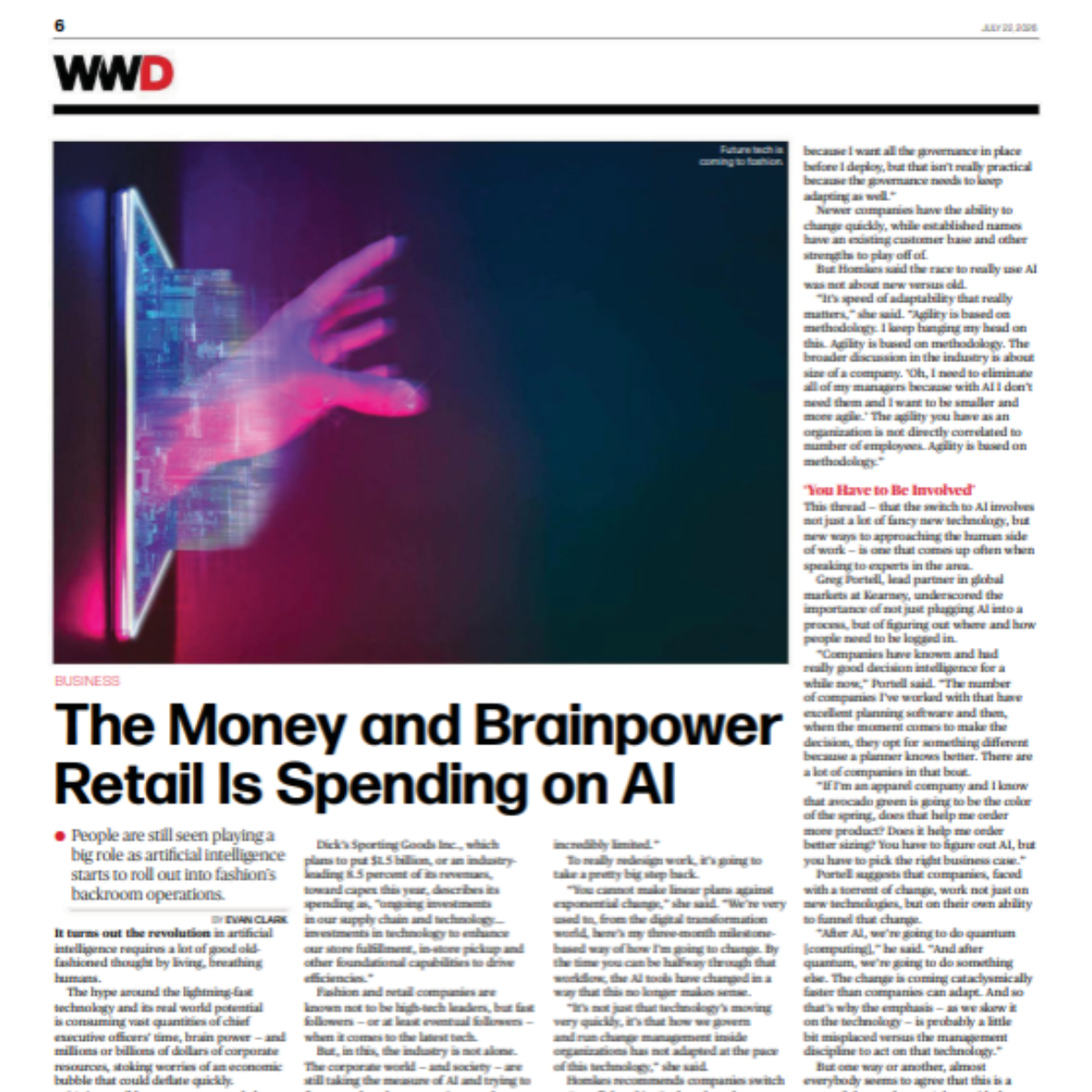
press July 2026 The Money and Brainpower Retail Is Spending on AI
WWD by Evan ClarkAchim weighs in on where fashion should direct its AI investments and why the real opportunity sits in the back end.
As fashion pours time and capital into artificial intelligence, companies across the industry are still working out where the technology genuinely creates value. Achim notes that most CEOs remain unsure how much to invest, recognising that AI now carries real costs requiring management and dedicated budgets. He highlights that while attention has centred on consumer-facing applications, the larger opportunities lie in a long-neglected area where lead times, buying, and sourcing processes have barely changed in decades. The pressing challenge for leadership is developing a plan that makes the return on investment tangible rather than vague.
linkedin May 2026 AI is raising the bar – not leveling the field
AI is raising the bar – not leveling the field That was the conclusion of my recent interview of Zalando co-founder David Schneider. I’ve been spending a lot of time recently discussing AI with founders, operators, and platform leaders across the industry. One thing is clear: AI isn’t a future topic anymore – it’s already reshaping how fashion works. Yes, the tools are more accessible than ever. But the outcome isn’t democratization – it’s divergence. AI is making strong operators faster, sharper, and more precise: #personalization is better #reliable customer experiences are increasing #execution is becoming more clean AI is turning speed into a non-negotiable From demand planning to allocation, the entire system is accelerating. What used to take weeks now takes days – or hours. The implication? Agility is no longer a competitive edge. It’s the baseline. AI is forcing a mindset shift from brand to business For a long time, many believed product + brand storytelling would carry the model. AI is challenging that assumption. It rewards those who truly understand demand, operate with discipline, and think end-to-end. In other words: It pushes brands to become better retailers. And it will sort out those who don’t. Curious to hear your takes on the topic.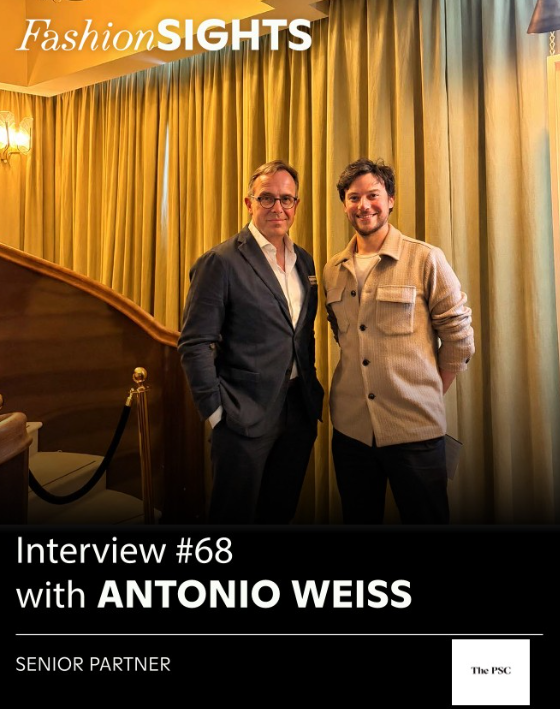
linkedin July 2026 Why has fashion been so slow to embrace technology?
In my latest interview with Antonio Weiss the Author of the #1 Bestseller "AI Demystified", we discussed why fashion’s resistance to technology has never simply been about conservatism. It has much more to do with what customers are actually buying. At premium and luxury price points, customers are not buying efficiency. They are buying craftsmanship, emotion, aspiration, and desire. And historically, technology has had little to add to that equation. Fashion is largely about emotion and AI does not naturally create emotion. But something has shifted. hashtag#AI has suddenly become more advanced, more accessible, and far more visible to consumers. Investment has surged. Adoption has accelerated. And a broad conviction has taken hold that AI will reshape how companies work, market, design, buy, and interact with customers. Still, the conversation also made clear that the AI wave is both real and overhyped. The technology is already creating efficiencies. It is changing workflows, lowering barriers in areas such as marketing and buying, and influencing how consumers search and shop. But the idea of instant transformation or AI-first mass customization at scale remains far more complicated than many expected. For fashion brands, the right AI strategy depends on what the brand stands for. Rejecting AI can be a legitimate choice. Going all in requires genuine ownership, not just dependency on third-party models. And for many brands, the smartest path may be to watch closely, learn fast, and follow when real-world use cases prove their value. The bigger question is not whether AI will matter. It already does. The bigger question is how fashion can use AI without losing what makes fashion valuable in the first place: emotion, craft, aspiration, and desire. Thank you, Antonio for the deeply insightful exchange! Further insights from this conversation will be featured in my upcoming book, bringing together leading voices shaping the hashtag#FutureOfFashion.linkedin Interview #68 with Antonio Weiss, Senior Partner; The PSC
Why has fashion been so slow to embrace technology? In my latest interview with Antonio Weiss the Author of the #1 Bestseller "AI Demystified", we discussed why fashion’s resistance to technology has never simply been about conservatism. It has much more to do with what customers are actually buying. At premium and luxury price points, customers are not buying efficiency. They are buying craftsmanship, emotion, aspiration, and desire. And historically, technology has had little to add to that equation. Fashion is largely about emotion and AI does not naturally create emotion. But something has shifted. hashtag#AI has suddenly become more advanced, more accessible, and far more visible to consumers. Investment has surged. Adoption has accelerated. And a broad conviction has taken hold that AI will reshape how companies work, market, design, buy, and interact with customers. Still, the conversation also made clear that the AI wave is both real and overhyped. The technology is already creating efficiencies. It is changing workflows, lowering barriers in areas such as marketing and buying, and influencing how consumers search and shop. But the idea of instant transformation or AI-first mass customization at scale remains far more complicated than many expected. For fashion brands, the right AI strategy depends on what the brand stands for. Rejecting AI can be a legitimate choice. Going all in requires genuine ownership, not just dependency on third-party models. And for many brands, the smartest path may be to watch closely, learn fast, and follow when real-world use cases prove their value. The bigger question is not whether AI will matter. It already does. The bigger question is how fashion can use AI without losing what makes fashion valuable in the first place: emotion, craft, aspiration, and desire. Thank you, Antonio for the deeply insightful exchange! Further insights from this conversation will be featured in my upcoming book, bringing together leading voices shaping the hashtag#FutureOfFashion.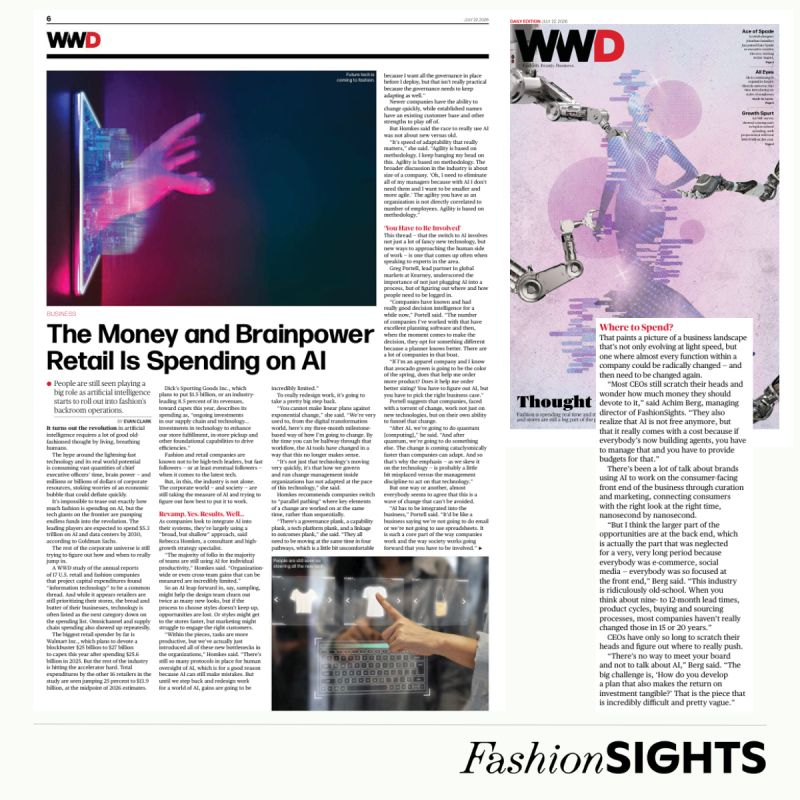
linkedin August 2026 “It turns out the revolution in artificial intelligence requ...
That is how Evan Clark opens his WWD deep dive into hashtag#AI spending in retail. I shared some of my own views in the article. First, the numbers tell part of the story. WWD reviewed the CapEx plans of 17 major US retail and fashion companies. Excluding Walmart, the remaining 16 expect their combined CapEx to rise by 25% to approximately $13.9 billion in 2026, based on the midpoints of their estimates. Of course, much of that investment remains directed toward stores. But information technology frequently appears next on the spending list, alongside omnichannel and supply-chain investments. However, more CapEx does not automatically mean money is well spent. For years, fashion companies have focused on the front end: e-commerce, social media, personalization, and the digital customer journey. Understandably so. But I see a larger, less obvious opportunity on the back end, particularly in product development, buying, and sourcing processes that many companies haven't fundamentally changed in 15 or 20 years. Take Levi Strauss & Co. as an example. CEO Michelle Gass said the company is nearing the end of a years-long ERP transformation that has improved its data and laid the foundation for incorporating AI into company processes. They are now deploying about 1,000 agents across supply chain, planning, and wholesale orders. But where does it go from here? Ten thousand agents? Hundred thousand? Nobody quite knows yet. This brings me to a more difficult leadership question. Budget planning must go hand in hand with accountability and measuring results. How do companies make the return on AI investment tangible? Who supervises the agents once they become part of operational processes? And who decides what success looks like? Over the past months, I have interviewed many of the industry’s leading executives for my upcoming book. AI frequently came up as an opportunity for fashion companies to rethink how they design, plan, source, operate, and even authenticate products. We will share more of what we learned soon. Thank you, Evan for including my perspective in this excellent piece. Link to the WWD article in the comments.
linkedin September 2026 Interview #71 with Jonathan Siboni, Founder & CEO; Luxurynsi...
This was a central thread of my recent conversation with Jonathan Siboni, Founder & CEO of Luxurynsight, who reads the industry through data, spanning brands, markets, and consumers. Jonathan shared his perspective on several of the forces reshaping the industry: how discretionary spending is increasingly driven by identity and conviction rather than income alone, how social media has fragmented cultural authority from a handful of global voices into millions, and why pricing, long treated as an afterthought, has become a strategic discipline that COVID exposed. One of the most intriguing parts of our conversation is luxury's gradual and belated move into digital, and how AI challenges the two foundations the industry is built on: intellectual property and creativity. The real risk, as Jonathan sees it, is not the technology itself but brands leaning on cheap tools without developing the judgment to protect what makes them valuable. A sincere thank you to you, Jonathan for such a precise and clear-eyed conversation and for grounding it in where you see luxury heading. This interview forms part of the research behind FashionSIGHTS' upcoming book on the #futureoffashion


